March 26, 2016

Gift from the Sea

Gift from the Sea is not the sort of book I would have picked up on my own. My book club is reading it this year though and it is a brief 138 pages, so I initially decided to “just get through it” and be done with it. Imagine my surprise when I began reading and found that much of what Anne Lindbergh wrote over 60 years ago still rings true.

I must admit that I hadn’t realized Anne was Charles Lindbergh’s wife until I looked her up after reading this book. I’m glad I didn’t know as I was reading though because instead of placing Anne on a pedestal of preconceived notions – famous aviator’s wife, famous aviator herself, daughter of a foreign diplomat, rich, privileged, etc – I was able to read her words as though she were just an average 1950’s housewife who happened to have a writing career.

Much of what Lindbergh wrote in the beginning of Gift from the Sea resonated with me as both a woman and a writer. Like Virginia Woolf, Morrow advocates that women need to find a way to detach themselves from daily distractions so that they can have a space of their own to create and be. “Women’s normal occupations run counter to creative life, or contemplative life, or saintly life” (29). How true this is! Morrow touches on the fact that women are by nature givers and nurturers and that they don’t resent the giving, so much as the feeling that they often give to no purpose. She writes, “no longer fed by a feeling of indispensability or purposefulness, we are hungry, and not knowing what we are hungry for, we fill up the void with endless distractions, always at hand – unnecessary errands, compulsive duties, social niceties. And for the most part, to little purpose.”
I can’t tell you how often I’ve made a mile long “To Do” list and driven myself nearly mad to get it done, only to find as I put the last checkmark in the last checkbox that many of the items weren’t really important at all – they were merely filler for my day, items to conquer in my quest for purposefulness.

What is Lindbergh’s answer to this search for purpose? It is two-fold: eliminate the unnecessary and seek solitude. When we do that, she believes we will find our “center” and begin filling it up with activities and relationships that sustain and renew us.

In what she calls, “the art of shedding” she states that we need to learn “how little, not how much can I get along with. To say – is it necessary? – when I am tempted to add one more accumulation to my life, when I am pushed toward one more centrifugal activity” (35). I was struck at how closely her thoughts resonate with the modern minimalist movement, which isn’t just about cleaning out your closet, but about eliminating internal clutter as well.

If we succeed in eliminating physical, internal, and emotional clutter we will be able to seek solitude in order to feed the “inner-life.”

Over sixty years ago Lindbergh wrote that the world does not understand people’s need for solitude and that is probably truer today. You run the risk of being labeled antisocial if you don’t have a Facebook page or Instagram account. Tell your children to turn off the TV because the noise is bothering you and they’ll probably think you’re in a bad mood. Imagine telling a friend that you can’t attend their party because it conflicts with your alone time! Most likely they would think you were not only rude, but in need of anti-depressants. In our society, one’s desire to be alone has been relegated to the status of a mental health issue. If only they understood what Lindbergh, and most introverts, understand: that “there is a quality to being alone that is incredibly precious. Life rushes back into the void, richer, more vivid, fuller than before. It is as if in parting one did actually lose an arm. And then, like the star-fish, one grows it anew; one is whole again, complete and round- more whole, even than before, when the other people had pieces of one” (42).

I can see why women were drawn to this book 60 years ago when the cult of domesticity raged and the idea that women deserved lives of their own was probably a bit foreign. Now, we live in an age when it’s not uncommon to go to a restaurant with music so loud you can hardly speak to the person across the table, which perhaps makes little difference when most everyone is on their iPhone texting, Facebooking, or playing a game. In this age of distraction, social isolation, and personal fragmentation, Lindbergh’s profoundly simple reflections from the sea still have the capacity to make us stop, think, and reevaluate our lives.


March 25, 2016

The House at Riverton

It almost seems unfair to say that I was disappointed in this book because it was Morton’s first novel and I still thought it was a fairly good story, but I did have a hard time getting through it the first time and it was even more difficult the second time (I reread it for book club).

The descriptions in this story were rich and textured, like a delicious piece of chocolate cake. The characters and plot, on the other hand, were more like vanilla pudding: sweet and edible, but unsubstantial.

The main character and narrator, Grace Bradley, whose job as a servant is unarguably dull, lacked the rich inner life to counter her profession. The other characters were similarly flat or became so within the course of the story. The descriptions of Grace in her old age reached a melodramatic pitch on her deathbed, “Finally, after ninety-nine years my end has come for me. The final thread that tethered me has released and the north wind blows me away. I am fading at last to nothing.” I could almost hear fake gasping noises and violin music swelling in the background as I read this.

I think the character that disappointed me the most was that of Hannah, whose rebellious and adventurous nature seemed so provocative at the beginning. I expected great things from her, but she became more and more spineless as the story went on.

I’m used to Morton’s explosive and unexpected endings, but this ending was more like a 4th of July firework that fizzles in the night sky. I got a few sparks and a poof of smoke when I expected a showy and colorful display.

The more interesting aspects of the novel were left unexplored. For instance, what exactly is “The Game” that is played between the Hartford siblings? What about the whole affair between Grace’s mother and her employer? Why is Grace’s daughter so bitter?

My other issue with this novel cannot really be blamed on Morton. Because of the time period and upstairs/downstairs drama, I kept picturing the Downton Abbey characters. This book was published in 2006 and Downton Abbey didn’t come out until 2010, so I know Morton wasn’t trying to copy the show, but because her characters were lacking in intensity, it was hard to give them a space and identity of their own.

Despite my complaints, I think this novel will be interesting to Morton fans, if only to see how well she has honed her craft within the past ten years.


February 2, 2016

Reflections on Laura Ingalls Wilder's Little House series and Anne of Green Gables

Several years ago, I decided to read my way through Laura Ingalls Wilder’s Little House books. It has been a lovely journey, full of cherished memories from my childhood and new discoveries. Wilder’s peculiar ability to make me want to run off to the Midwest and live on a claim shanty on the plains has not diminished as I grow older. There is something beautiful about the simplicity of living that resonates with my minimalistic tendencies. For instance, the scene where Laura tidies her marriage home is one of my favorites. She goes about putting everything in order and it is described as a “bright and shining little house.” She spreads “a bright red tablecloth” over her table and “the cloth had a beautiful border and made the table an ornament fit for anyone’s front room. In the corner between the window to the east and the window to the south was a small stand-table with an easy armchair at one side and a small rocker at the other. Above it suspended from the ceiling was a glass lamp with glittering pendants. That was the parlor part of the room, and when the copies of Scott’s and Tennyson’s poems were on the stand it would be complete. She would have some geraniums growing in cans on the windows soon and then it would be simply beautiful.”

That single red tablecloth, the hope of bright geraniums in the windows, and the certainty that two volumes of poetry will be just the thing to make your home complete – it really is perfect. There’s no clutter. No stacks of junk. When you have few things to treasure, everything you own is of great worth. I’m sure as a child this wasn’t the reason I was drawn to these books, but as an adult, I continually come back to it. When Laura declares to Manly that, “I have always lived in little houses. I like them,” it resonates with me.

As I finished reading the last three books in the series this month – Little Town on the Prairie, These Happy Golden Years, and The First Four Years, I found that though these books are good, they are not nearly as enchanting as the first six books in the series.

As the spirited little girl grows into a teenager and adult, it’s as though bits of Laura become erased until there’s nothing but a faint outline of her. Some of this is the result of what happens when characters grow up, but the genre doesn’t. Veiled in Victorian modesty, Laura’s courtship with Manly was almost comically unromantic. The most passion to be found in their engagement is when Laura returns home with a ring on her finger and Ma says,” Sometimes I think it is the horses you care for, more than their master.” To which Laura replies, “I couldn’t have one without the other” and “Laura knew they understood what she was too shy to say.”

As I was reading, I was struck by the many similarities between these books and Lucy Maud Montgomery’s Anne books. Montgomery has Tennyson, Wilder her folk songs, but they tell pretty much the same story of growth from girlhood to adulthood. While Montgomery writes with a humor that is utterly lacking in Wilder’s prose, Wilder takes the prize for realism. Want to know what happens when a twister hits your house or a freak snowstorm occurs when you’re out walking? It’s not pretty.

Though the writer’s methods vary, Anne and Laura essentially share the same fate as adult characters. Anne recedes into the background as the Anne series progresses and anecdotes of her plentiful offspring take center stage. Wilder tries to keep Laura at the forefront of the story, with rather disastrous results. The First Four Years was a bit of a shock. I kept asking myself, “what happened here?!” It wasn’t until I had finished reading it that I discovered that it was an unfinished draft, published long after Laura Ingalls Wilder’s death. Much like Harper Lee’s, Go Set a Watchman, one wonders if the publishing of this manuscript was a disservice to the legacy of the author.

What’s done is done though and the magic is almost quite gone in The First Four Years, which chronicles, at a rather brisk pace, Laura and Almanzo’s first four years of marriage. Strange incidents, like Mr. Boast offering to trade a horse for Laura and Almanzo’s baby, because they could have more children and his wife could have none, occur. Tragedy strikes over and over again - a burned down house, the loss of a baby, a crop that has failed three years in a row, and crushing debt. Gone are the days of music, laughter, star shine and violets. It’s as though Wilder is trying to prove that no matter how bright the flame of girlhood burns, there is nothing adulthood won’t bring your way that won’t attempt to extinguish it.

Both Montgomery and Wilder illustrate that when faced with the practicalities of married life, homes of their own, and babies, the dowdy, overworked housewife is waiting, just around the corner, to invade the optimistic girl of yore. Who has time to dream when there is a farm to take care of and children to bring up?

And, yet, I can’t see the adult Anne and Laura as failures of their childhood selves. I believe their success as characters rests not so much in what they became, as what they didn’t become. It is the absence of poor qualities that continues to distinguish them as valuable characters. For Anne, success meant not becoming a small-minded gossip and busybody. For Laura, success is avoiding mental breakdown and not becoming a wild, knife-wielding plainswoman (see book seven) that threatens to murder her husband in the night because he won’t take her back to civilization. Victory is not only being able to survive in a harsh environment, but also being able to see the beauty and poetry in it. Oh, and not killing your husband when he doggedly tells you there’s nowhere else for you to go. That is an accomplishment.

Anne retains her ability to dream and Laura retains her work ethic and pioneer spirit. These qualities enable Laura to not only survive, but also thrive in a harsh and unforgiving environment. In reading her story, I have felt my own “spirit rising for the struggle.”


January 6, 2016

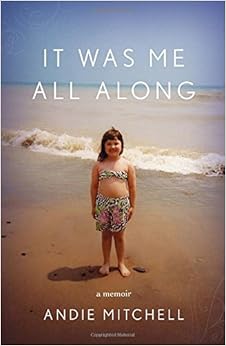
It Was Me All Along

The New Year seemed like a good time to read a book about how one woman lost over 130 pounds.

I have never read a weight loss memoir, but Andie Mitchell’s story is just what I expected from the genre: pages of contemplations as to why one overeats; long, tedious descriptions of once loved fatty foods; a stint in counseling; self-obsession, over exercising, and the realization that there is more to life than a treadmill and calorie counting. It’s all here.

While I don’t think this was the author’s intent, I came away from this reading experience with a sense of just how selfish eating disorders can be. Like any addiction, an eating disorder means that someone is completely focused on himself or herself. They may not be happy, they may not be able to control it, but the world revolves around them and the foods they eat or don’t eat. It is sad not just for the person with the disorder, but for their friends and family.

Weight loss aside, the author’s journey embodies the self-absorption, lack of substance and direction that typifies her entire generation. She partied through high school and college, went to Europe for a semester to study film, graduated with no real plan, collected a bunch of student loan debt, has a hard-working mother (who no doubt has never had the luxury of going to Europe) that is willing to pay for her plastic surgery, and after a seven year relationship she decides she has outgrown her significant other and “fallen out of love” (big eye roll for that one). They break up, she moves away, and four years later they are engaged (that part is not in the book, but on her blog).

Her life isn’t about what she can give back to people or how she can do something important that will contribute to the well being of others. No, she is troubled by the need to “find” herself, express her creativity, and grow. To read her story is to read the egocentric motivations of an entire generation.

So, I didn’t love this memoir. I didn’t hate it either. I respect the author’s weight loss journey, even if I do find her to be lacking in substance. To endure the loss of a parent at such a young age and to be left alone so often would lead some people down far darker paths than obsessively eating cake, cereal, and donuts.


December 30, 2015

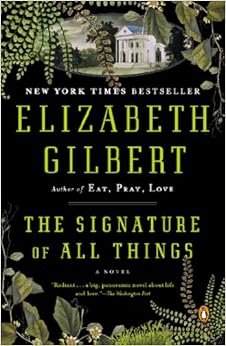
The Signature of All Things

I took a Flowering Plants class when I was in college. It was one of those science courses you sign up for because it looks easier than Analytical Chemistry and slightly less boring than The History and Philosophy of Science. I was asked to splice open plants and look at them under the microscope and I learned how to correctly dry, press, and preserve them. I was also required to collect and correctly identify fifty different flowers. My friends and I spent a lot of time that quarter pulling up random weed-like flowers from the side of the road and going on long hikes in the quest for ever more impressive specimens. I learned Latin names and can still remember some: Rosaceae, Ranunculaceae, Juglandaceae. I found a sort of ridiculous thrill in being able to use the Latin name for a flower or tree. Why call a Buttercup a Buttercup when it is so much more impressive and informative to call it Ranunculaceae? And the mystery of why I didn’t have more friends in college continues to deepen…

My experience in that class was a bit like my experience reading The Signature of All Things: tedious and sometimes boring, yet intellectually stimulating with its own brand of fun.

This novel tells the story of Alma Whittaker. Alma is born in 1800 and is the daughter of a botanical explorer turned botanical magnate, and a staunch Dutch mother with sharp intellectual abilities who teaches her daughter how to be rational, scientific, and a most tireless problem solver. Alma gains an adoptive sister who perplexes her and she falls in love with a man who simultaneously confounds and devastates her. The setting moves from England, various ships, America, Tahiti, and the Netherlands.

Science in the 1800's is fascinating: gas lamps and telescopes, balloonists and fearless botanical explorers - it was a regular carnival of discovery. Ever since reading The Age of Wonder, Richard Holmes’ magnificent treatise on science in the 18th and 19th centuries, I have had a special affinity for this time period and the beautiful sense of intellectual trailblazing that so many intrepid scientists and explorers experienced as they delved into science like never before. This is why, despite my incredible dislike for Gilbert’s Eat, Pray, Love (I believe I compared that reading experience to rolling around in sheets of fiberglass insulation), I astonished myself by purchasing this book and saying something along the lines of, “this actually looks good.” And it was good. Sort of.

One of the most satisfying things about this novel is that Gilbert centered it on a woman who defies all the stereotypes of a heroine. She is not beautiful. Men do not desire her. She does not live the conventional life of a wife and mother, nor does she gain fulfillment in the traditional sense. Yet she is successful, satisfied (more or less), and happy. Her sensual desires keep her from becoming stodgy, but there is very little romance in her character. Alma isn’t always likeable, but she is believable and well developed.

While I enjoyed reading this book, I imagine that many people will find it tiresome. Alma studies moss, which then becomes allegorical for her own life. Moss is resilient, moss is strong, moss is adaptable, moss isn’t sexy and it isn’t impressive or very interesting to most people, but it can be beautiful in its own way. Alma is moss and not everyone will have the patience for moss.


December 2, 2015

The Storm Sister

I was so excited to read this book that I actually ordered it from Amazon UK so I could read it months before the US release date in March. Perhaps the only logical conclusion to such feelings of excitement and anticipation is disappointment.

The Storm Sister is the second book in Lucinda Riley’s ambitious venture to write a seven book series that chronicles the adopted daughters of “Pa Salt.” After his death, each sister is given clues to go in search of her past. There is also a larger mystery as to what actually happened to Pa Salt, why he decided to adopt each of the sisters, and who he really was. Also, all clues point to the fact that Pa Salt isn't really dead...

I found Ally’s story interesting, but ultimately unfulfilling. The “mystery” of her birth was almost blatantly obvious to me. What Riley failed to do was to give any real clues as to why Ally was given up for adoption and why Pa Salt chose her. Also, large portions of this novel were very similar to Riley’s The Italian Girl, which I have found to be her least intriguing novel.

I honestly wonder if Riley hasn’t bitten off more than she can chew with this series. The first book was excellent, but by committing to publish a new book every year (I’m assuming that’s the plan), she may not be giving herself enough time to fully develop her stories and give them the polish that such books as The Lavender Garden and The Orchid House had.

Final verdict: the first book in this series was excellent, the second one is just OK. It is entertaining and I would still recommend it, but don’t expect too much from it.


November 15, 2015

The Lake House

Don’t read this novel if you have an overflowing “To Do” list, if you value your sleep, or if you need to clean your house from top to bottom for Thanksgiving company, because you will become an unproductive zombie with a dirty house. :) That’s pretty much what happened to me. By the time I got to the last quarter of the book I decided to just sit down and finish it, which was hard to do with a toddler. Luckily, I had some peanut butter cookies on hand for those “just a few more pages” or “just one more chapter” moments.

The Lake House is set in beautiful Cornwall and mainly bounces back and forth between the 1930s and 2003. It involves several family mysteries, a missing child, and a web of family relationships so complex you just might lay awake until 3 a.m. trying to untangle it all.

I have loved all of Morton’s novels, but The Lake House ranks up there with my other favorite, The Forgotten Garden. Morton is a master of atmosphere, suspense, and plot. I can tell she is well versed in Victorian Gothic literature. Some might say her endings are too “neat,” but I prefer to see them as fearlessly satisfying and refreshingly lacking in cynicism.

My recommendation is to immediately get yourself a copy of this novel. Then, grab a warm blanket, a cup of hot chocolate, curl up in your favorite chair and let those long autumn evenings become your friend.


UP